Consumer Checklist
Questions to Ask Your Vet
Choosing a veterinary hospital is not just choosing a doctor. It can also mean choosing a business model.
Many pet owners assume a veterinary hospital is locally owned because the name sounds local, the staff live nearby, or the building has been in the community for years. That is not always the full picture.
Some hospitals are independently owned. Others are owned or financially backed by corporate chains, private-equity-backed platforms, venture-capital-funded companies, retail pet companies, or veterinary support organizations.
Are you independently owned?
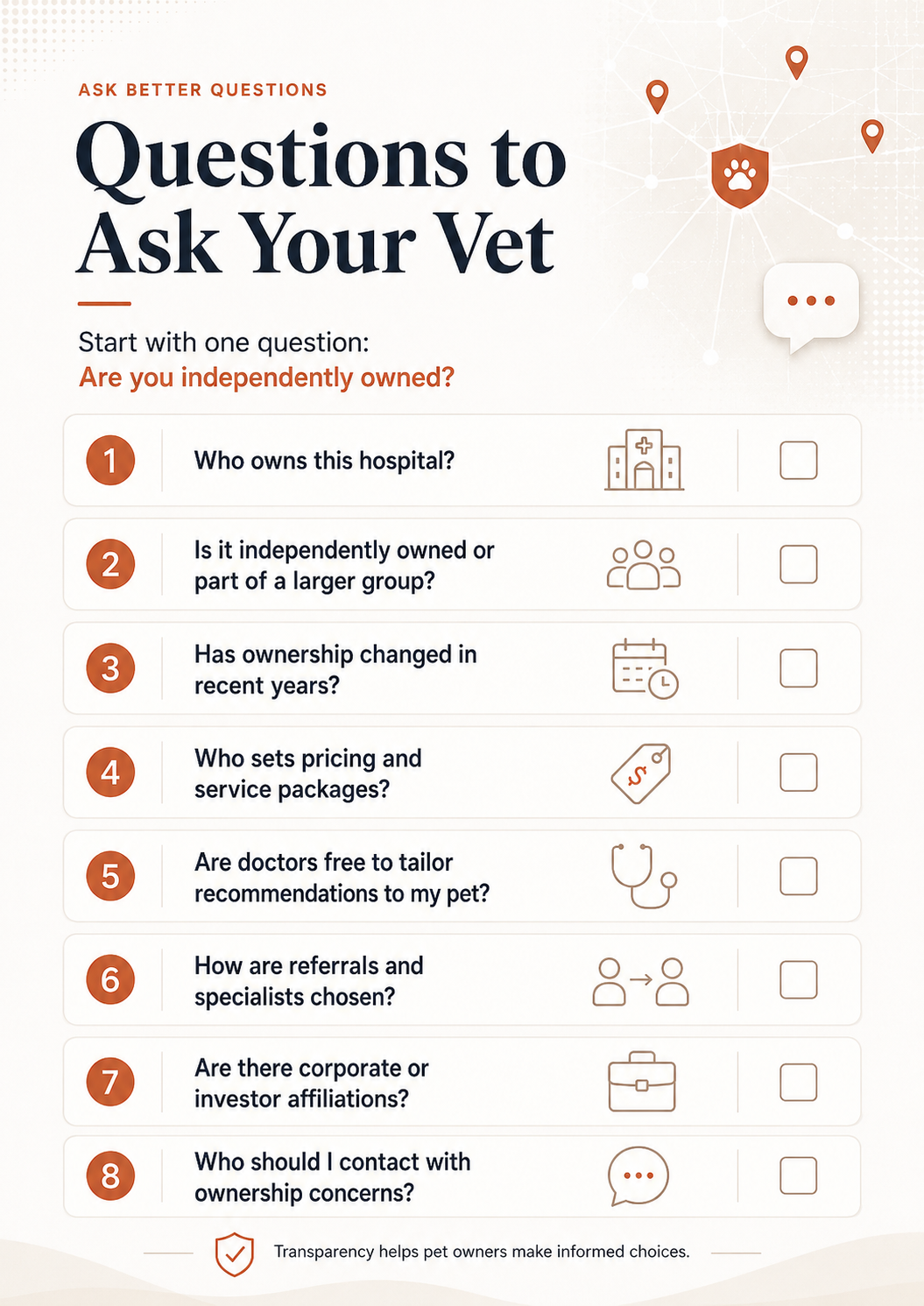
The 10 questions to ask
- Are you independently owned?
- If not, who owns or financially backs this hospital?
- Is ownership disclosed on your website?
- Who sets pricing?
- Who controls staffing budgets?
- Are veterinarians given production or revenue targets?
- Are treatment protocols controlled locally or by a parent company?
- Who owns or controls your online pharmacy?
- Are referral pathways influenced by ownership relationships?
- How can clients verify your ownership structure?
Why these questions matter
Ownership does not automatically determine medical quality. Many excellent veterinarians, technicians, receptionists, assistants, managers, and hospital leaders work inside corporate-owned hospitals.
But ownership can influence the business structure behind care. Pet owners deserve to know who controls the hospital, who sets business priorities, and whether decisions are made locally or through a larger corporate, investor-backed, retail, or veterinary-support organization.
What to listen for
A clear answer might sound like:
“Yes, we are independently owned.”
Or:
“No, we are owned by [company name], and that ownership is disclosed here.”
A vague answer might sound like:
- “We are locally operated.”
- “Our doctors make medical decisions.”
- “We are part of a family of hospitals.”
- “We have support from a veterinary partner.”
- “Ownership does not affect care.”
Those answers may be true, but they do not fully answer the ownership question. If the hospital is not independently owned, pet owners can still ask who owns or financially backs the business.
Key distinction
“Locally operated” is not the same thing as “locally owned.” A hospital can have local doctors and staff while still being owned, backed, or managed by a larger corporate or investor-backed organization.
Ask before the emergency
These questions are easiest to ask before there is a crisis.
In routine care, you have time to compare hospitals, review options, and ask about ownership. In an emergency, you usually go wherever care is available. That is why it helps to understand your local veterinary options before your pet is sick, injured, or unstable.
Ownership is one factor, not the only factor
Ownership transparency matters, but it is not the only thing to consider.
When choosing a veterinary hospital, also consider:
- Medical quality
- Doctor communication
- Technician skill and staffing
- Appointment access
- Emergency planning
- Diagnostic capability
- Continuity of care
- Pricing transparency
- Client education
- Trust
How to use this checklist
You do not need to ask every question at once. Start with the first one:
Are you independently owned?
If the answer is yes, ask where that ownership is disclosed.
If the answer is no, ask who owns or financially backs the hospital.
If the answer is unclear, ask where clients can verify the hospital’s ownership structure.
Bottom line
This is not about attacking veterinarians or staff. It is about informed consumer choice.
Pet owners deserve clear answers before they trust a hospital with their animal.
Before you book, ask who owns your vet.