Consumer Education
Why Veterinary Ownership Matters
Choosing a veterinary hospital is not just choosing a doctor. It can also mean choosing a business model.
Many veterinary hospitals are independently owned and locally accountable. Others are owned or financially backed by corporate chains, private-equity firms, venture-capital-funded companies, retail pet companies, or veterinary support organizations.
Ownership does not automatically determine medical quality. Many excellent veterinarians, technicians, receptionists, assistants, managers, and hospital leaders work inside corporate-owned hospitals. But ownership can influence the incentives, policies, and business structure behind the exam room.
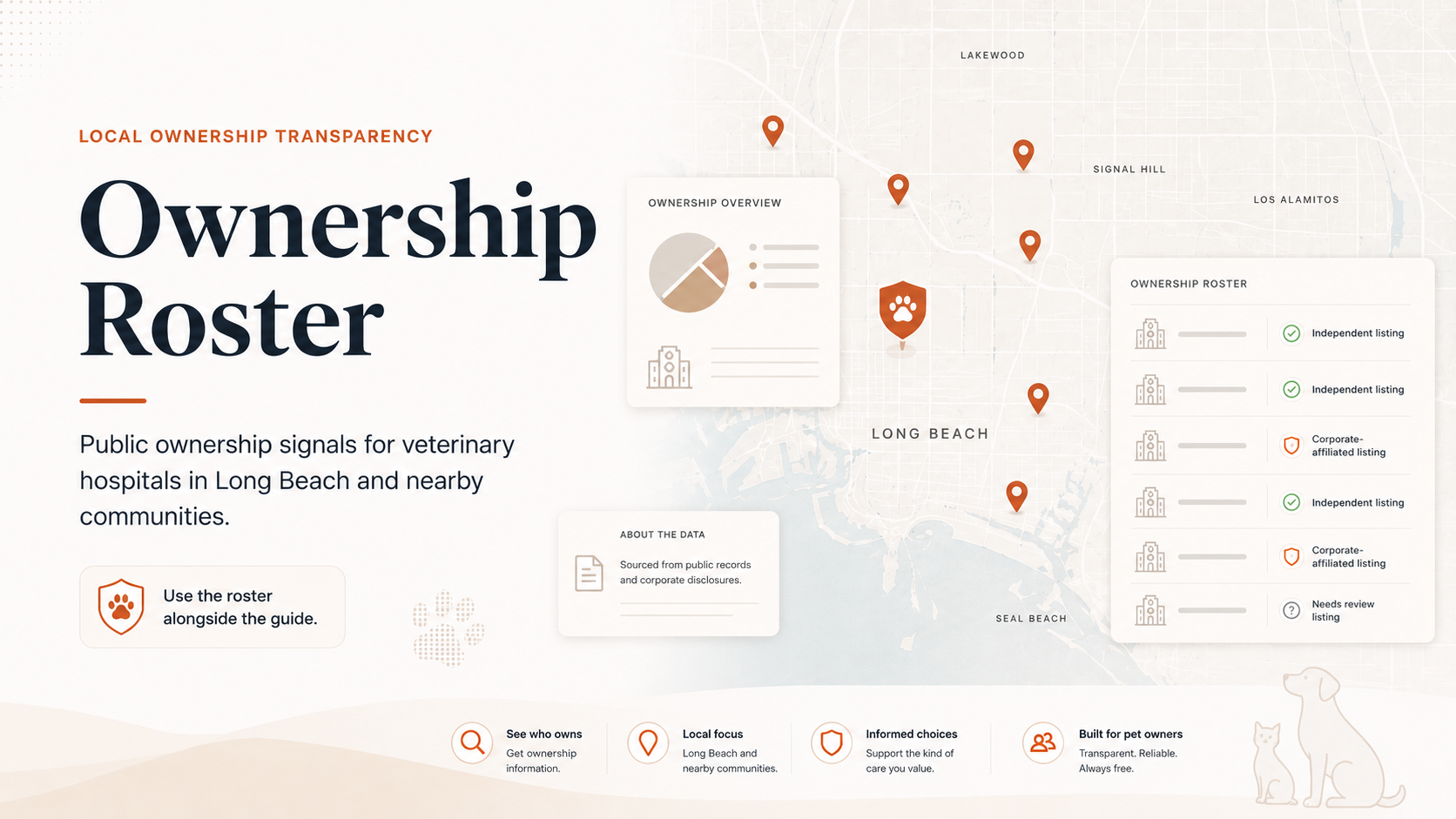
The issue is whether pet owners know who owns or financially backs the hospital before choosing care.
Ownership can influence incentives
Corporate, private-equity-backed, venture-backed, retail-owned, or veterinary-support-organization-affiliated hospitals may operate under different business incentives than independently owned hospitals.
Depending on the organization, ownership may influence:
- Pricing models
- Staffing budgets
- Appointment length
- Doctor compensation and production targets
- Treatment-plan protocols
- Pharmacy policy
- Online prescription strategy
- Referral pathways
- Emergency and specialty access
- Local decision-making
- Client communication
- Continuity of care
Private equity and venture capital can change the business model
Private-equity and venture-backed models are commonly built around growth, scale, operational efficiency, market expansion, and investor return. Those goals are not automatically incompatible with good medicine, but they can create pressure inside the business.
In veterinary care, that pressure may show up through price increases, productivity expectations, staffing models, standardized protocols, pharmacy strategy, referral relationships, or expansion into emergency and specialty care.
Pet owners usually do not see those business structures directly. They experience the result through appointment availability, pricing, communication, staffing, continuity, and the options offered when their pet needs care.
Emergency and specialty care deserve special attention
Ownership transparency is especially important in emergency and specialty medicine because pet owners often have less choice during a crisis.
In routine care, a client can compare hospitals, ask questions, and schedule elsewhere. In an emergency, clients usually go wherever care is available. When a pet is crashing, seizing, bleeding, bloating, or struggling to breathe, there is no time to research ownership structure.
That is why consolidation in emergency and specialty veterinary care matters for consumers. When fewer ownership groups control more emergency and specialty access points, pet owners may have fewer truly independent options when they need care most.
Local branding does not always mean local ownership
Some corporate veterinary hospitals are obvious because the brand name is visible. Others continue to use familiar local-facing names even when public sources connect them to larger ownership or support platforms.
A hospital may have a neighborhood name, local staff, and a familiar building while still being owned, backed, or managed by a national chain, private-equity platform, venture-funded company, retail pet corporation, or veterinary support organization.
Pet owners should not have to search corporate career pages, job postings, investor announcements, state records, or public business filings to understand who owns the hospital caring for their animal.
The simple question
Are you independently owned?
If the answer is no, ask who owns or financially backs the hospital and where that ownership is disclosed publicly.
Transparency is not anti-veterinarian
This project is not an attack on veterinarians, technicians, receptionists, assistants, managers, or hospital staff.
Many excellent veterinary professionals work inside corporate-owned, private-equity-backed, venture-backed, retail-owned, and veterinary-support-organization-affiliated hospitals.
The point is simple: pet owners deserve to know the ownership structure behind the hospital before they choose care.
What pet owners should ask
- Are you independently owned?
- If not, who owns or financially backs this hospital?
- Is ownership disclosed on your website?
- Who sets pricing?
- Who controls staffing budgets?
- Are veterinarians given production or revenue targets?
- Are treatment protocols controlled locally or by a parent company?
- Who owns or controls your online pharmacy?
- Are referral pathways influenced by ownership relationships?
- How can clients verify your ownership structure?
Bottom line
Corporate ownership does not automatically mean poor medicine. Independent ownership does not automatically mean better medicine.
But ownership structure can shape the business incentives behind care. Pet owners deserve transparency before they trust a hospital with their animal.
Before you book, ask who owns your vet.